
BlackCoat journal
By BlackCoat Services
4 min read
A practical guide to 3D printing for Staffordshire businesses
Practical ways Staffordshire businesses can assess 3D printing for prototypes, workplace parts, branded items and short production runs.
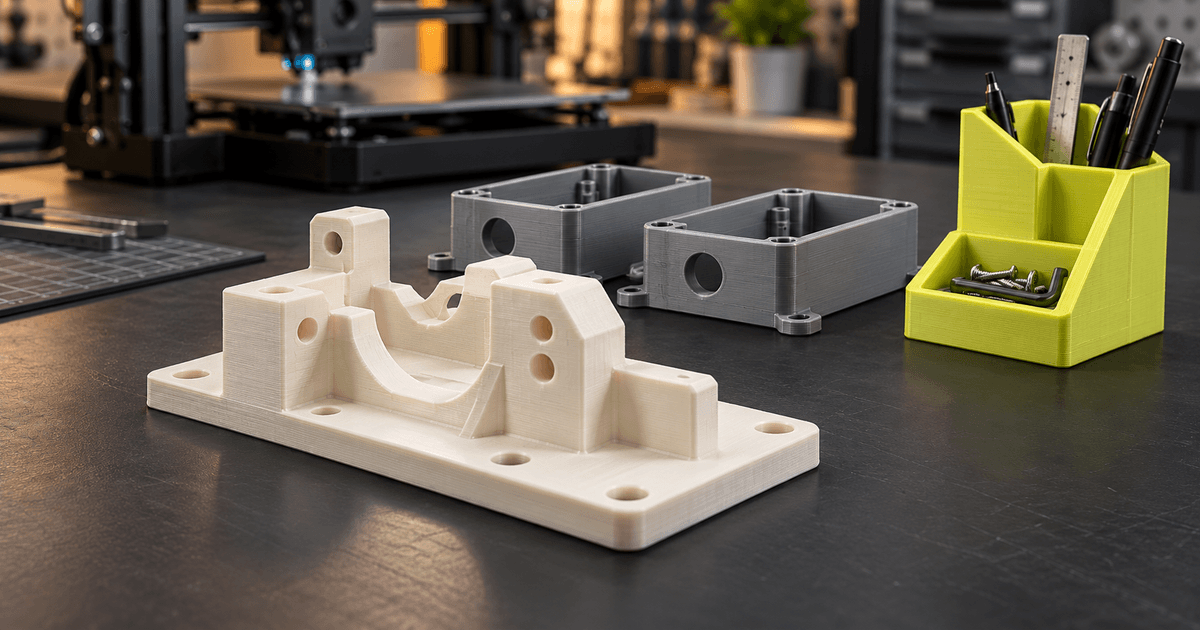
Staffordshire businesses can discuss a design locally and have printed parts delivered elsewhere in the UK. The same questions about use, geometry, quantity and finish apply whether a part stays near Lichfield or is sent to another UK site.
Additive production is worth considering when a part benefits from digital iteration, custom geometry or production without dedicated conventional tooling. It is not automatically the cheapest or fastest route. A clear review should compare the intended use, quantity, deadline and alternatives before work begins.
Prototypes for useful decisions
A prototype should answer a stated question. It might help a team review overall form, check access around an assembly, discuss an interface or handle a concept before further development. Write down the decision the prototype must support, because that determines which details need to be representative and which can remain simplified.
Replacement parts
An unavailable or altered workplace part may be a candidate for redesign and printing, but copying its outside shape is not enough. The review should cover why the original is being replaced, how it fits, what loads and environment apply, and whether another production method is more suitable. Existing geometry may be measured or captured as a starting point before CAD development.
Jigs and fixtures
Jigs and fixtures can hold, locate, guide or protect work during a repeatable task. A useful brief describes the operation, contact surfaces, operator interaction and any components the item must avoid. That context helps the design review account for access, assembly and replacement rather than focusing only on the shape shown in a sketch.
Custom workplace items
Phone stands, pen holders, tool organisers, labels and other custom workplace items can be adapted to a particular desk, bench or internal identity. Their apparent simplicity still deserves a brief: specify what they hold, where they sit, how they are cleaned and which visual details matter. Branded keyrings similarly need agreement on artwork, readable features, attachment geometry and intended handling.
Short runs and repeat supply
Short runs can suit parts that need variants, are not yet ready for conventional tooling, or are required in modest quantities. The first approved part should establish revision, acceptance points and production assumptions. Repeat orders can then refer to that controlled information, while any design change is reviewed explicitly rather than folded into the order unnoticed.
When another route may be better
3D printing should not be chosen only to avoid discussing alternatives. Quantity, geometry, required finish, working conditions and future demand may point towards another manufacturing route or a redesigned part. A responsible review can conclude that additive production is useful for development but not for the eventual production requirement.
From brief to delivery
- Brief: share the current file, sketch or reference item with its intended use, quantity, finish and deadline.
- Review: clarify geometry, critical interfaces, process options, file readiness and acceptance points.
- Quote: agree the revision, production scope, checks, delivery destination and any separate design work.
- Produce: make the approved scope and keep revision details clear for any repeat requirement.
- Deliver: check and pack the parts for the agreed UK destination with the order information.
Keeping a local enquiry broadly useful
Being based in Staffordshire can make early discussion convenient, particularly when an existing item or physical context needs explanation. The project record should still be clear enough to support review, quoting, production and UK delivery without relying on an informal conversation. Use the quote route to send the core details, then add local context where it genuinely helps explain the requirement.
Next steps